


Compliance Innovation Amid Geopolitical Change
Hear insights from industry experts at our Financial Crime Compliance Risk Ready event, exploring how UK institutions are adapting to geopolitical uncertainty and evolving regulatory demands.
- Home
- Insights and Resources
- Navigating Financial Crime Compliance Uncertainty
Navigating Uncertainty: Compliance Innovation in the Face of Geopolitical and Regulatory Change.
We recently brought together a panel of experts from across banking and insurance to explore how UK financial institutions are navigating geopolitical uncertainty and rising regulatory expectations.
Representatives from TLT LLP and Lloyd’s of London discussed how firms are evolving their approaches to AML, screening, and sanctions compliance, while also using regulatory change as a catalyst to improve data quality, reduce false positives and drive innovation.
In this article, we share the key insights from the panel, along with results from our audience polls to provide a broader view of how other firms are tackling these challenges.
Navigating Geopolitical Risk
A central theme was the growing impact of geopolitical risk on financial crime compliance. Our speakers emphasised that the geopolitical agenda, particularly policies on high-risk countries remains directly relevant to sanctions compliance. However, the influence of global instability extends across all economic crime disciplines, from anti-money laundering (AML) to counter-terrorist financing (CTF) and fraud. The panel noted that 2026 will see the UK and its G7 allies intensify efforts to tackle “kleptocracy”, making it crucial for firms to align their economic crime strategies across sanctions, AML/CTF, and anti-bribery and corruption (AB&C).
Geopolitical events are creating daily challenges and complexities for compliance teams. Divergence in global sanctions regimes post-Brexit, and differing US, UK, and EU stances, are generating exploitable grey areas for bad actors. Increasingly, banks and insurers are integrating risk, credit, cyber, and compliance teams for a more joined-up approach, reflecting broader trends in cross-sector collaboration.
Regulatory Pressure and Industry Response
Regulatory scrutiny remains high, with several high-profile fines issued to peer institutions in 2025 underscoring the need for robust controls. The panel discussed how these enforcement actions serve as important lessons, particularly around transaction monitoring and sanctions reporting. The pace and scope of regulatory expectations, especially regarding sanctions and AML, are rapidly increasing. Recent high-profile misses, demonstrate the need for more robust screening of assets and beneficial ownership.
Oversight is increasingly centralised under MLRO teams, enabling aggregation and escalation of concerns across the enterprise. There is a persistent tension between robust crime prevention and commercial growth, particularly SME lending. Practical steps for improvement include thorough asset screening, better cross-team communication, and embracing regulatory guidance. Regulatory and cultural barriers to cross-sector data sharing persist, with calls for greater clarity from the FCA and broader legal frameworks to enable safe, trusted information exchange.
Data Quality, False Positives, and Collaboration
While data quality and the reduction of false positives remain ongoing challenges, the speakers agreed that these issues are increasingly being addressed through industry collaboration and the adoption of higher standards. Recent sanctions developments have heightened the value of scenario testing and investment in new tools, as well as the creation of specialist teams for proactive investigation. The UK banking sector is seen as a leader in public-private partnerships (PPP), but there is recognition that more can be done, particularly in testing new legislative provisions and moving beyond information sharing to coordinated, end-to-end threat mitigation.
Barriers to collaboration include data privacy, legal uncertainty, and cultural hesitancy, despite new provisions in the Economic Crime and Corporate Transparency Act. Voluntary data sharing partnerships, such as the Joint Money Laundering Intelligence Taskforce, are being piloted, with positive but gradual results. The insurance sector is increasingly engaged in information sharing with authorities, offering unique insights on global assets. Effective compliance is linked to reliable, consolidated customer data and nimble teams using advanced data tools. Technology, including AI and real-time monitoring, is a double-edged sword, improving risk detection but also creating new challenges in determining actionable intelligence.
Looking Ahead
Looking to the future, the panel reflected on the broader role of financial institutions in supporting national and global security objectives. There was a recognition of the tension between economic crime prevention and other priorities, such as ensuring access to banking and supporting commercial growth. The speakers agreed that flexibility and adaptability will be essential, as the regulatory and geopolitical landscape continues to evolve. Best-in-class compliance for 2026 is seen as context-specific but universally reliant on high-quality, unified data and collaboration across all lines of defence. The UK is seen as having an opportunity to show global leadership in compliance and sanctions, especially as US leadership and multilateral coordination wanes. Public-private partnership and cross-sectoral collaboration are regarded as pivotal, with a call to action for UK stakeholders to be proactive in anti-corruption and information sharing.
During the panel session, we invited the audience—senior leaders from banking, insurance, pensions, and investments—to weigh in on some of the same questions posed to our panellists. Below are the responses, offering a snapshot of current thinking and priorities across the financial services sector.
Compliance Landscape Word Cloud Poll
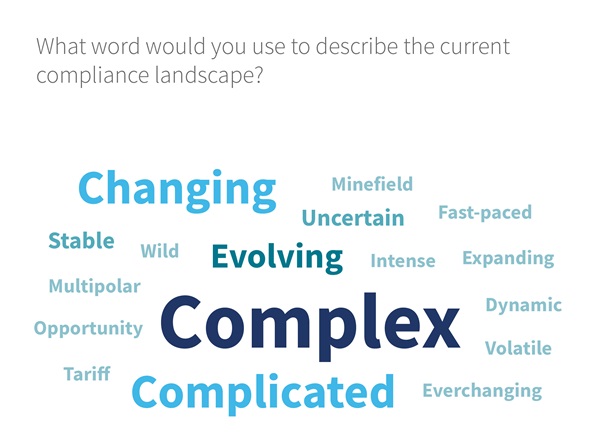
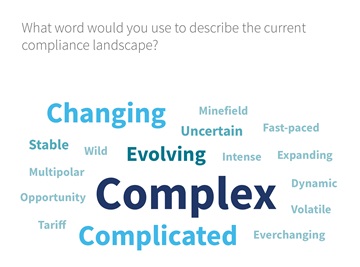
Participants were asked to describe the current compliance landscape in one word. The most prominent responses were “Complex”, “Changing”, “Complicated”, and “Evolving”, with other terms like “Uncertain”, “Volatile”, and “Stable” also appearing. This reflects a collective sense that compliance in financial services is multifaceted and rapidly shifting, driven by ongoing regulatory changes and geopolitical uncertainty. The prevalence of words such as “Minefield” and “Dynamic” further highlights the challenges institutions face in navigating this environment.
Risk Tolerance and Onboarding Approach Poll
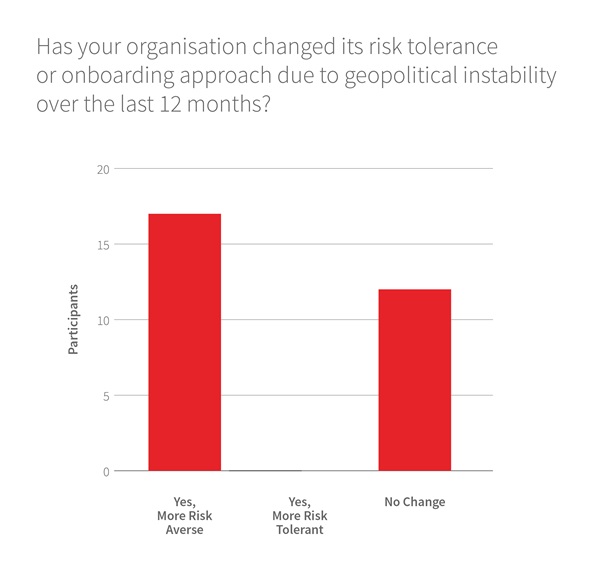
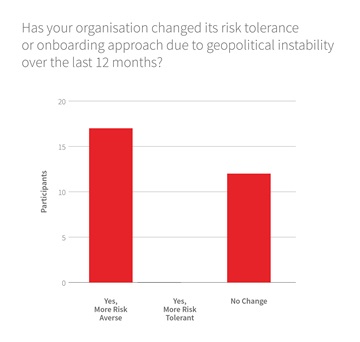
Attendees were asked whether their organisation had changed its risk tolerance or onboarding approach due to geopolitical instability in the past 12 months. The majority (59%) reported becoming more risk averse, while none indicated a shift towards greater risk tolerance. 41% said there had been no change. This suggests that recent global events have prompted most financial institutions to adopt a more cautious stance, prioritising risk mitigation over expansion or experimentation in their onboarding processes.
Compliance Budget Expectations Poll
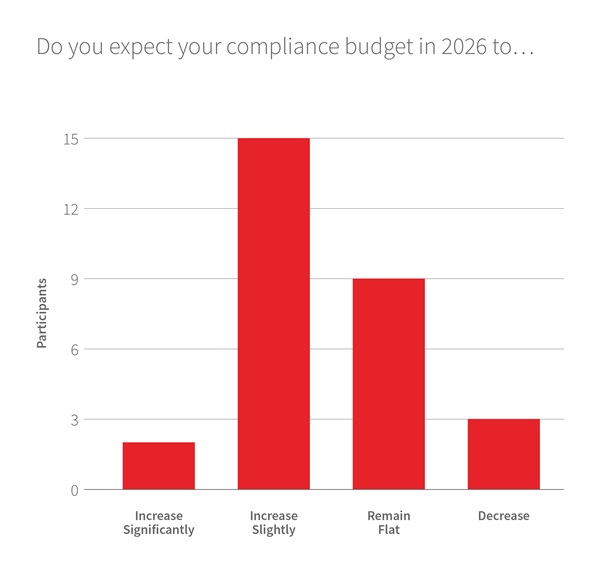
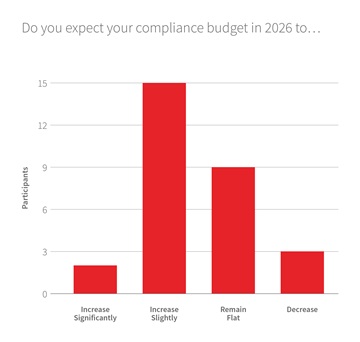
When asked about expectations for their compliance budgets in 2026, 52% of respondents anticipated a slight increase, 31% expected budgets to remain flat, and only 7% foresaw a significant increase. Meanwhile, 10% predicted a decrease. These results indicate that while most organisations expect to allocate more resources to compliance, the increases are likely to be modest, reflecting both the importance of compliance and the need to balance costs in a challenging economic climate.
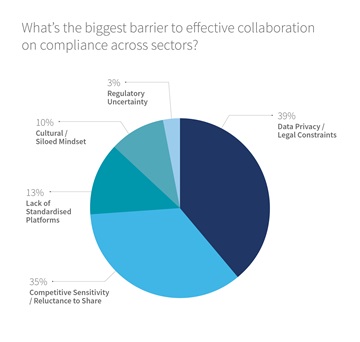
What is the biggest barrier to effective collaboration on compliance across sectors?
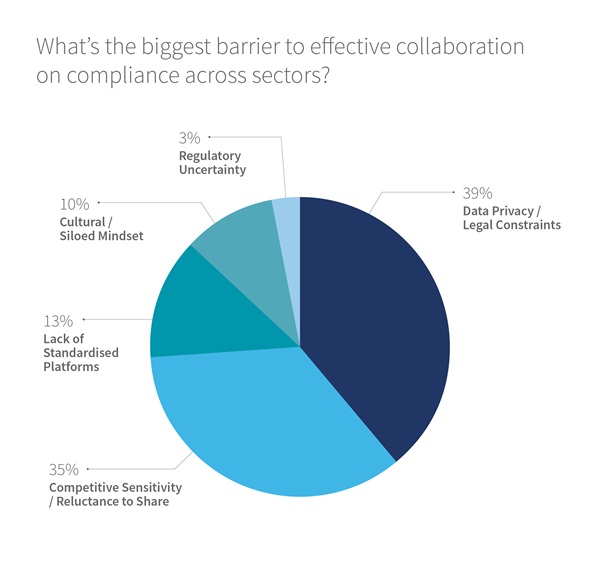
The poll reveals that the biggest barrier to effective collaboration on compliance across sectors is data privacy and legal constraints, cited by 39% of respondents. Close behind, competitive sensitivity and reluctance to share was identified by 35% of participants. Other challenges include the lack of standardised platforms (13%) and cultural or siloed mindsets (10%), while regulatory uncertainty was considered the least significant obstacle at just 3%. These insights highlight that trust and legal frameworks remain the most critical hurdles to cross-sector collaboration.
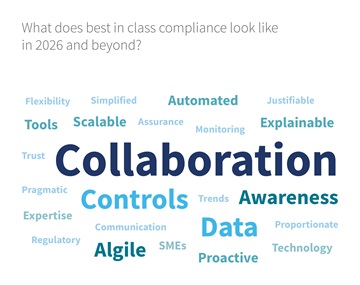
What does ‘best-in-class' compliance look like in 2026
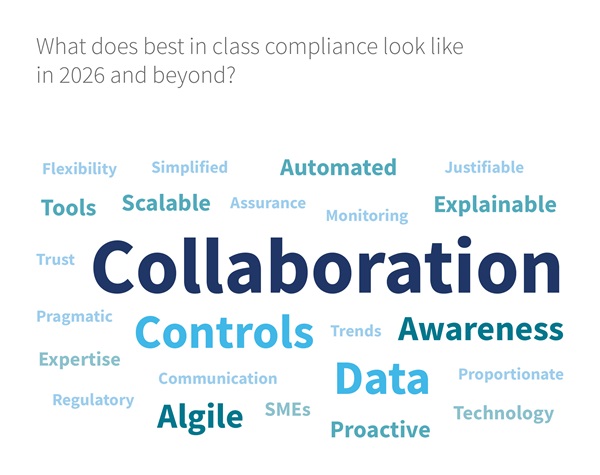
The open poll on “best-in-class compliance” for 2026 and beyond revealed a strong consensus around the importance of collaboration, adaptability, and technology. Many respondents highlighted cross-functional teamwork, integrated tools, and data-driven approaches as essential features of future compliance. There was a clear emphasis on transparency, robust controls, and subject matter expertise, alongside the need for pragmatic, scalable, and agile solutions. The responses also pointed to the value of proactive risk management, accessible data, and flexible platforms that enable organisations to assess, react, and filter risks efficiently. Overall, the analysis suggests that leaders in financial services see best-in-class compliance as a blend of technical capability, collaborative culture, and the agility to respond to an ever-changing regulatory landscape.
Suggested Action Items from the breakout session
To address the challenges and opportunities highlighted during the panel, the following practical actions are recommended for organisations seeking to strengthen their compliance frameworks and stay ahead of emerging risks:
The opinions expressed here are those of the contributors and do not necessarily reflect the views of LexisNexis® Risk Solutions or its partners.
Representatives from TLT LLP and Lloyd’s of London discussed how firms are evolving their approaches to AML, screening, and sanctions compliance, while also using regulatory change as a catalyst to improve data quality, reduce false positives and drive innovation.
In this article, we share the key insights from the panel, along with results from our audience polls to provide a broader view of how other firms are tackling these challenges.
Navigating Geopolitical Risk
A central theme was the growing impact of geopolitical risk on financial crime compliance. Our speakers emphasised that the geopolitical agenda, particularly policies on high-risk countries remains directly relevant to sanctions compliance. However, the influence of global instability extends across all economic crime disciplines, from anti-money laundering (AML) to counter-terrorist financing (CTF) and fraud. The panel noted that 2026 will see the UK and its G7 allies intensify efforts to tackle “kleptocracy”, making it crucial for firms to align their economic crime strategies across sanctions, AML/CTF, and anti-bribery and corruption (AB&C).
Geopolitical events are creating daily challenges and complexities for compliance teams. Divergence in global sanctions regimes post-Brexit, and differing US, UK, and EU stances, are generating exploitable grey areas for bad actors. Increasingly, banks and insurers are integrating risk, credit, cyber, and compliance teams for a more joined-up approach, reflecting broader trends in cross-sector collaboration.
The discussion highlighted how geopolitical volatility and rising regulatory expectations are reshaping financial crime compliance across the industry. While the audience clearly reflected a sense of complexity and uncertainty in today’s compliance landscape, the panel also saw real opportunity within that complexity. Panellists agreed that success now depends on breaking down silos between sanctions, AML, fraud and wider risk teams and improving the quality and usability of data. The message was clear, firms that invest in collaboration, unified data and agile operating models are best placed to turn compliance from a regulatory challenge into a source of resilience and differentiation.
Daniel Bisson, Director Market Planning, LexisNexis® Risk Solutions
Daniel Bisson, Director Market Planning, LexisNexis® Risk Solutions
Regulatory Pressure and Industry Response
Regulatory scrutiny remains high, with several high-profile fines issued to peer institutions in 2025 underscoring the need for robust controls. The panel discussed how these enforcement actions serve as important lessons, particularly around transaction monitoring and sanctions reporting. The pace and scope of regulatory expectations, especially regarding sanctions and AML, are rapidly increasing. Recent high-profile misses, demonstrate the need for more robust screening of assets and beneficial ownership.
Oversight is increasingly centralised under MLRO teams, enabling aggregation and escalation of concerns across the enterprise. There is a persistent tension between robust crime prevention and commercial growth, particularly SME lending. Practical steps for improvement include thorough asset screening, better cross-team communication, and embracing regulatory guidance. Regulatory and cultural barriers to cross-sector data sharing persist, with calls for greater clarity from the FCA and broader legal frameworks to enable safe, trusted information exchange.
Data Quality, False Positives, and Collaboration
While data quality and the reduction of false positives remain ongoing challenges, the speakers agreed that these issues are increasingly being addressed through industry collaboration and the adoption of higher standards. Recent sanctions developments have heightened the value of scenario testing and investment in new tools, as well as the creation of specialist teams for proactive investigation. The UK banking sector is seen as a leader in public-private partnerships (PPP), but there is recognition that more can be done, particularly in testing new legislative provisions and moving beyond information sharing to coordinated, end-to-end threat mitigation.
Barriers to collaboration include data privacy, legal uncertainty, and cultural hesitancy, despite new provisions in the Economic Crime and Corporate Transparency Act. Voluntary data sharing partnerships, such as the Joint Money Laundering Intelligence Taskforce, are being piloted, with positive but gradual results. The insurance sector is increasingly engaged in information sharing with authorities, offering unique insights on global assets. Effective compliance is linked to reliable, consolidated customer data and nimble teams using advanced data tools. Technology, including AI and real-time monitoring, is a double-edged sword, improving risk detection but also creating new challenges in determining actionable intelligence.
Looking Ahead
Looking to the future, the panel reflected on the broader role of financial institutions in supporting national and global security objectives. There was a recognition of the tension between economic crime prevention and other priorities, such as ensuring access to banking and supporting commercial growth. The speakers agreed that flexibility and adaptability will be essential, as the regulatory and geopolitical landscape continues to evolve. Best-in-class compliance for 2026 is seen as context-specific but universally reliant on high-quality, unified data and collaboration across all lines of defence. The UK is seen as having an opportunity to show global leadership in compliance and sanctions, especially as US leadership and multilateral coordination wanes. Public-private partnership and cross-sectoral collaboration are regarded as pivotal, with a call to action for UK stakeholders to be proactive in anti-corruption and information sharing.
Audience Polls
During the panel session, we invited the audience—senior leaders from banking, insurance, pensions, and investments—to weigh in on some of the same questions posed to our panellists. Below are the responses, offering a snapshot of current thinking and priorities across the financial services sector.
Compliance Landscape Word Cloud Poll
Participants were asked to describe the current compliance landscape in one word. The most prominent responses were “Complex”, “Changing”, “Complicated”, and “Evolving”, with other terms like “Uncertain”, “Volatile”, and “Stable” also appearing. This reflects a collective sense that compliance in financial services is multifaceted and rapidly shifting, driven by ongoing regulatory changes and geopolitical uncertainty. The prevalence of words such as “Minefield” and “Dynamic” further highlights the challenges institutions face in navigating this environment.
Risk Tolerance and Onboarding Approach Poll
Attendees were asked whether their organisation had changed its risk tolerance or onboarding approach due to geopolitical instability in the past 12 months. The majority (59%) reported becoming more risk averse, while none indicated a shift towards greater risk tolerance. 41% said there had been no change. This suggests that recent global events have prompted most financial institutions to adopt a more cautious stance, prioritising risk mitigation over expansion or experimentation in their onboarding processes.
Compliance Budget Expectations Poll
When asked about expectations for their compliance budgets in 2026, 52% of respondents anticipated a slight increase, 31% expected budgets to remain flat, and only 7% foresaw a significant increase. Meanwhile, 10% predicted a decrease. These results indicate that while most organisations expect to allocate more resources to compliance, the increases are likely to be modest, reflecting both the importance of compliance and the need to balance costs in a challenging economic climate.
What is the biggest barrier to effective collaboration on compliance across sectors?
The poll reveals that the biggest barrier to effective collaboration on compliance across sectors is data privacy and legal constraints, cited by 39% of respondents. Close behind, competitive sensitivity and reluctance to share was identified by 35% of participants. Other challenges include the lack of standardised platforms (13%) and cultural or siloed mindsets (10%), while regulatory uncertainty was considered the least significant obstacle at just 3%. These insights highlight that trust and legal frameworks remain the most critical hurdles to cross-sector collaboration.
What does ‘best-in-class' compliance look like in 2026
The open poll on “best-in-class compliance” for 2026 and beyond revealed a strong consensus around the importance of collaboration, adaptability, and technology. Many respondents highlighted cross-functional teamwork, integrated tools, and data-driven approaches as essential features of future compliance. There was a clear emphasis on transparency, robust controls, and subject matter expertise, alongside the need for pragmatic, scalable, and agile solutions. The responses also pointed to the value of proactive risk management, accessible data, and flexible platforms that enable organisations to assess, react, and filter risks efficiently. Overall, the analysis suggests that leaders in financial services see best-in-class compliance as a blend of technical capability, collaborative culture, and the agility to respond to an ever-changing regulatory landscape.
Suggested Action Items from the breakout session
To address the challenges and opportunities highlighted during the panel, the following practical actions are recommended for organisations seeking to strengthen their compliance frameworks and stay ahead of emerging risks:
 |
Strengthen internal communication and aggregation of compliance concerns across teams. |
| |
Invest in dynamic, real-time risk assessment tools, including AI for horizon scanning. |
| |
Advocate for greater regulatory clarity and legal frameworks to support safe data sharing. |
| |
Expand and formalise cross-sector partnerships, especially between banks and insurers. |
| |
Prioritise high-quality, consolidated customer and asset data management. |
| |
Pursue proactive engagement with government on anti-corruption initiatives and public-private partnerships. |
The opinions expressed here are those of the contributors and do not necessarily reflect the views of LexisNexis® Risk Solutions or its partners.
We recently brought together a panel of experts from across banking and insurance to explore how UK financial institutions are navigating geopolitical uncertainty and rising regulatory expectations.
Representatives from TLT LLP and Lloyd’s of London discussed how firms are evolving their approaches to AML, screening, and sanctions compliance, while also using regulatory change as a catalyst to improve data quality, reduce false positives and drive innovation.
In this article, we share the key insights from the panel, along with results from our audience polls to provide a broader view of how other firms are tackling these challenges.
Navigating Geopolitical Risk
A central theme was the growing impact of geopolitical risk on financial crime compliance. Our speakers emphasised that the geopolitical agenda, particularly policies on high-risk countries remains directly relevant to sanctions compliance. However, the influence of global instability extends across all economic crime disciplines, from anti-money laundering (AML) to counter-terrorist financing (CTF) and fraud. The panel noted that 2026 will see the UK and its G7 allies intensify efforts to tackle “kleptocracy”, making it crucial for firms to align their economic crime strategies across sanctions, AML/CTF, and anti-bribery and corruption (AB&C).
Geopolitical events are creating daily challenges and complexities for compliance teams. Divergence in global sanctions regimes post-Brexit, and differing US, UK, and EU stances, are generating exploitable grey areas for bad actors. Increasingly, banks and insurers are integrating risk, credit, cyber, and compliance teams for a more joined-up approach, reflecting broader trends in cross-sector collaboration.
Regulatory Pressure and Industry Response
Regulatory scrutiny remains high, with several high-profile fines issued to peer institutions in 2025 underscoring the need for robust controls. The panel discussed how these enforcement actions serve as important lessons, particularly around transaction monitoring and sanctions reporting. The pace and scope of regulatory expectations, especially regarding sanctions and AML, are rapidly increasing. Recent high-profile misses, demonstrate the need for more robust screening of assets and beneficial ownership.
Oversight is increasingly centralised under MLRO teams, enabling aggregation and escalation of concerns across the enterprise. There is a persistent tension between robust crime prevention and commercial growth, particularly SME lending. Practical steps for improvement include thorough asset screening, better cross-team communication, and embracing regulatory guidance. Regulatory and cultural barriers to cross-sector data sharing persist, with calls for greater clarity from the FCA and broader legal frameworks to enable safe, trusted information exchange.
Data Quality, False Positives, and Collaboration
While data quality and the reduction of false positives remain ongoing challenges, the speakers agreed that these issues are increasingly being addressed through industry collaboration and the adoption of higher standards. Recent sanctions developments have heightened the value of scenario testing and investment in new tools, as well as the creation of specialist teams for proactive investigation. The UK banking sector is seen as a leader in public-private partnerships (PPP), but there is recognition that more can be done, particularly in testing new legislative provisions and moving beyond information sharing to coordinated, end-to-end threat mitigation.
Barriers to collaboration include data privacy, legal uncertainty, and cultural hesitancy, despite new provisions in the Economic Crime and Corporate Transparency Act. Voluntary data sharing partnerships, such as the Joint Money Laundering Intelligence Taskforce, are being piloted, with positive but gradual results. The insurance sector is increasingly engaged in information sharing with authorities, offering unique insights on global assets. Effective compliance is linked to reliable, consolidated customer data and nimble teams using advanced data tools. Technology, including AI and real-time monitoring, is a double-edged sword, improving risk detection but also creating new challenges in determining actionable intelligence.
Looking Ahead
Looking to the future, the panel reflected on the broader role of financial institutions in supporting national and global security objectives. There was a recognition of the tension between economic crime prevention and other priorities, such as ensuring access to banking and supporting commercial growth. The speakers agreed that flexibility and adaptability will be essential, as the regulatory and geopolitical landscape continues to evolve. Best-in-class compliance for 2026 is seen as context-specific but universally reliant on high-quality, unified data and collaboration across all lines of defence. The UK is seen as having an opportunity to show global leadership in compliance and sanctions, especially as US leadership and multilateral coordination wanes. Public-private partnership and cross-sectoral collaboration are regarded as pivotal, with a call to action for UK stakeholders to be proactive in anti-corruption and information sharing.
During the panel session, we invited the audience—senior leaders from banking, insurance, pensions, and investments—to weigh in on some of the same questions posed to our panellists. Below are the responses, offering a snapshot of current thinking and priorities across the financial services sector.
Compliance Landscape Word Cloud Poll
Participants were asked to describe the current compliance landscape in one word. The most prominent responses were “Complex”, “Changing”, “Complicated”, and “Evolving”, with other terms like “Uncertain”, “Volatile”, and “Stable” also appearing. This reflects a collective sense that compliance in financial services is multifaceted and rapidly shifting, driven by ongoing regulatory changes and geopolitical uncertainty. The prevalence of words such as “Minefield” and “Dynamic” further highlights the challenges institutions face in navigating this environment.
Risk Tolerance and Onboarding Approach Poll
Attendees were asked whether their organisation had changed its risk tolerance or onboarding approach due to geopolitical instability in the past 12 months. The majority (59%) reported becoming more risk averse, while none indicated a shift towards greater risk tolerance. 41% said there had been no change. This suggests that recent global events have prompted most financial institutions to adopt a more cautious stance, prioritising risk mitigation over expansion or experimentation in their onboarding processes.
Compliance Budget Expectations Poll
When asked about expectations for their compliance budgets in 2026, 52% of respondents anticipated a slight increase, 31% expected budgets to remain flat, and only 7% foresaw a significant increase. Meanwhile, 10% predicted a decrease. These results indicate that while most organisations expect to allocate more resources to compliance, the increases are likely to be modest, reflecting both the importance of compliance and the need to balance costs in a challenging economic climate.
What is the biggest barrier to effective collaboration on compliance across sectors?
The poll reveals that the biggest barrier to effective collaboration on compliance across sectors is data privacy and legal constraints, cited by 39% of respondents. Close behind, competitive sensitivity and reluctance to share was identified by 35% of participants. Other challenges include the lack of standardised platforms (13%) and cultural or siloed mindsets (10%), while regulatory uncertainty was considered the least significant obstacle at just 3%. These insights highlight that trust and legal frameworks remain the most critical hurdles to cross-sector collaboration.
What does ‘best-in-class' compliance look like in 2026
The open poll on “best-in-class compliance” for 2026 and beyond revealed a strong consensus around the importance of collaboration, adaptability, and technology. Many respondents highlighted cross-functional teamwork, integrated tools, and data-driven approaches as essential features of future compliance. There was a clear emphasis on transparency, robust controls, and subject matter expertise, alongside the need for pragmatic, scalable, and agile solutions. The responses also pointed to the value of proactive risk management, accessible data, and flexible platforms that enable organisations to assess, react, and filter risks efficiently. Overall, the analysis suggests that leaders in financial services see best-in-class compliance as a blend of technical capability, collaborative culture, and the agility to respond to an ever-changing regulatory landscape.
Suggested Action Items from the breakout session
To address the challenges and opportunities highlighted during the panel, the following practical actions are recommended for organisations seeking to strengthen their compliance frameworks and stay ahead of emerging risks:
The opinions expressed here are those of the contributors and do not necessarily reflect the views of LexisNexis® Risk Solutions or its partners.
Representatives from TLT LLP and Lloyd’s of London discussed how firms are evolving their approaches to AML, screening, and sanctions compliance, while also using regulatory change as a catalyst to improve data quality, reduce false positives and drive innovation.
In this article, we share the key insights from the panel, along with results from our audience polls to provide a broader view of how other firms are tackling these challenges.
Navigating Geopolitical Risk
A central theme was the growing impact of geopolitical risk on financial crime compliance. Our speakers emphasised that the geopolitical agenda, particularly policies on high-risk countries remains directly relevant to sanctions compliance. However, the influence of global instability extends across all economic crime disciplines, from anti-money laundering (AML) to counter-terrorist financing (CTF) and fraud. The panel noted that 2026 will see the UK and its G7 allies intensify efforts to tackle “kleptocracy”, making it crucial for firms to align their economic crime strategies across sanctions, AML/CTF, and anti-bribery and corruption (AB&C).
Geopolitical events are creating daily challenges and complexities for compliance teams. Divergence in global sanctions regimes post-Brexit, and differing US, UK, and EU stances, are generating exploitable grey areas for bad actors. Increasingly, banks and insurers are integrating risk, credit, cyber, and compliance teams for a more joined-up approach, reflecting broader trends in cross-sector collaboration.
The discussion highlighted how geopolitical volatility and rising regulatory expectations are reshaping financial crime compliance across the industry. While the audience clearly reflected a sense of complexity and uncertainty in today’s compliance landscape, the panel also saw real opportunity within that complexity. Panellists agreed that success now depends on breaking down silos between sanctions, AML, fraud and wider risk teams and improving the quality and usability of data. The message was clear, firms that invest in collaboration, unified data and agile operating models are best placed to turn compliance from a regulatory challenge into a source of resilience and differentiation.
Daniel Bisson, Director Market Planning, LexisNexis® Risk Solutions
Daniel Bisson, Director Market Planning, LexisNexis® Risk Solutions
Regulatory Pressure and Industry Response
Regulatory scrutiny remains high, with several high-profile fines issued to peer institutions in 2025 underscoring the need for robust controls. The panel discussed how these enforcement actions serve as important lessons, particularly around transaction monitoring and sanctions reporting. The pace and scope of regulatory expectations, especially regarding sanctions and AML, are rapidly increasing. Recent high-profile misses, demonstrate the need for more robust screening of assets and beneficial ownership.
Oversight is increasingly centralised under MLRO teams, enabling aggregation and escalation of concerns across the enterprise. There is a persistent tension between robust crime prevention and commercial growth, particularly SME lending. Practical steps for improvement include thorough asset screening, better cross-team communication, and embracing regulatory guidance. Regulatory and cultural barriers to cross-sector data sharing persist, with calls for greater clarity from the FCA and broader legal frameworks to enable safe, trusted information exchange.
Data Quality, False Positives, and Collaboration
While data quality and the reduction of false positives remain ongoing challenges, the speakers agreed that these issues are increasingly being addressed through industry collaboration and the adoption of higher standards. Recent sanctions developments have heightened the value of scenario testing and investment in new tools, as well as the creation of specialist teams for proactive investigation. The UK banking sector is seen as a leader in public-private partnerships (PPP), but there is recognition that more can be done, particularly in testing new legislative provisions and moving beyond information sharing to coordinated, end-to-end threat mitigation.
Barriers to collaboration include data privacy, legal uncertainty, and cultural hesitancy, despite new provisions in the Economic Crime and Corporate Transparency Act. Voluntary data sharing partnerships, such as the Joint Money Laundering Intelligence Taskforce, are being piloted, with positive but gradual results. The insurance sector is increasingly engaged in information sharing with authorities, offering unique insights on global assets. Effective compliance is linked to reliable, consolidated customer data and nimble teams using advanced data tools. Technology, including AI and real-time monitoring, is a double-edged sword, improving risk detection but also creating new challenges in determining actionable intelligence.
Looking Ahead
Looking to the future, the panel reflected on the broader role of financial institutions in supporting national and global security objectives. There was a recognition of the tension between economic crime prevention and other priorities, such as ensuring access to banking and supporting commercial growth. The speakers agreed that flexibility and adaptability will be essential, as the regulatory and geopolitical landscape continues to evolve. Best-in-class compliance for 2026 is seen as context-specific but universally reliant on high-quality, unified data and collaboration across all lines of defence. The UK is seen as having an opportunity to show global leadership in compliance and sanctions, especially as US leadership and multilateral coordination wanes. Public-private partnership and cross-sectoral collaboration are regarded as pivotal, with a call to action for UK stakeholders to be proactive in anti-corruption and information sharing.
Audience Polls
During the panel session, we invited the audience—senior leaders from banking, insurance, pensions, and investments—to weigh in on some of the same questions posed to our panellists. Below are the responses, offering a snapshot of current thinking and priorities across the financial services sector.
Compliance Landscape Word Cloud Poll
Participants were asked to describe the current compliance landscape in one word. The most prominent responses were “Complex”, “Changing”, “Complicated”, and “Evolving”, with other terms like “Uncertain”, “Volatile”, and “Stable” also appearing. This reflects a collective sense that compliance in financial services is multifaceted and rapidly shifting, driven by ongoing regulatory changes and geopolitical uncertainty. The prevalence of words such as “Minefield” and “Dynamic” further highlights the challenges institutions face in navigating this environment.
Risk Tolerance and Onboarding Approach Poll
Attendees were asked whether their organisation had changed its risk tolerance or onboarding approach due to geopolitical instability in the past 12 months. The majority (59%) reported becoming more risk averse, while none indicated a shift towards greater risk tolerance. 41% said there had been no change. This suggests that recent global events have prompted most financial institutions to adopt a more cautious stance, prioritising risk mitigation over expansion or experimentation in their onboarding processes.
Compliance Budget Expectations Poll
When asked about expectations for their compliance budgets in 2026, 52% of respondents anticipated a slight increase, 31% expected budgets to remain flat, and only 7% foresaw a significant increase. Meanwhile, 10% predicted a decrease. These results indicate that while most organisations expect to allocate more resources to compliance, the increases are likely to be modest, reflecting both the importance of compliance and the need to balance costs in a challenging economic climate.
What is the biggest barrier to effective collaboration on compliance across sectors?
The poll reveals that the biggest barrier to effective collaboration on compliance across sectors is data privacy and legal constraints, cited by 39% of respondents. Close behind, competitive sensitivity and reluctance to share was identified by 35% of participants. Other challenges include the lack of standardised platforms (13%) and cultural or siloed mindsets (10%), while regulatory uncertainty was considered the least significant obstacle at just 3%. These insights highlight that trust and legal frameworks remain the most critical hurdles to cross-sector collaboration.
What does ‘best-in-class' compliance look like in 2026
The open poll on “best-in-class compliance” for 2026 and beyond revealed a strong consensus around the importance of collaboration, adaptability, and technology. Many respondents highlighted cross-functional teamwork, integrated tools, and data-driven approaches as essential features of future compliance. There was a clear emphasis on transparency, robust controls, and subject matter expertise, alongside the need for pragmatic, scalable, and agile solutions. The responses also pointed to the value of proactive risk management, accessible data, and flexible platforms that enable organisations to assess, react, and filter risks efficiently. Overall, the analysis suggests that leaders in financial services see best-in-class compliance as a blend of technical capability, collaborative culture, and the agility to respond to an ever-changing regulatory landscape.
Suggested Action Items from the breakout session
To address the challenges and opportunities highlighted during the panel, the following practical actions are recommended for organisations seeking to strengthen their compliance frameworks and stay ahead of emerging risks:
| |
Strengthen internal communication and aggregation of compliance concerns across teams. |
| |
Invest in dynamic, real-time risk assessment tools, including AI for horizon scanning. |
| |
Advocate for greater regulatory clarity and legal frameworks to support safe data sharing. |
| |
Expand and formalise cross-sector partnerships, especially between banks and insurers. |
| |
Prioritise high-quality, consolidated customer and asset data management. |
| |
Pursue proactive engagement with government on anti-corruption initiatives and public-private partnerships. |
The opinions expressed here are those of the contributors and do not necessarily reflect the views of LexisNexis® Risk Solutions or its partners.

This document is for informational purposes only and does not guarantee the functionality or features of any LexisNexis Risk Solutions products identified.
LexisNexis Risk Solutions does not represent nor warrant that this document is complete or error free. LexisNexis, LexID and the Knowledge Burst logo
are registered trademarks of RELX Inc. Other products or services may be trademarks or registered trademarks of their respective companies.
Copyright © 2026 LexisNexis Risk Solutions.
LexisNexis Risk Solutions does not represent nor warrant that this document is complete or error free. LexisNexis, LexID and the Knowledge Burst logo
are registered trademarks of RELX Inc. Other products or services may be trademarks or registered trademarks of their respective companies.
Copyright © 2026 LexisNexis Risk Solutions.
Related Resources
Products You May Be Interested In
-
Bridger Insight® XG
Powerful screening and ongoing monitoring platform for financial crime compliance
Learn More -
Firco™ Compliance Link
Manage customer, transaction and trade compliance screening with a single solution
Learn More -
RiskNarrative®
Orchestration platform providing a highly sophisticated, configurable and accessible financial crime lifecycle management solution.
Learn More -
WorldCompliance™ Data
Robust databases of high-risk individuals and entities including PEPs, sanctions, adverse media and enforcements
Learn More